
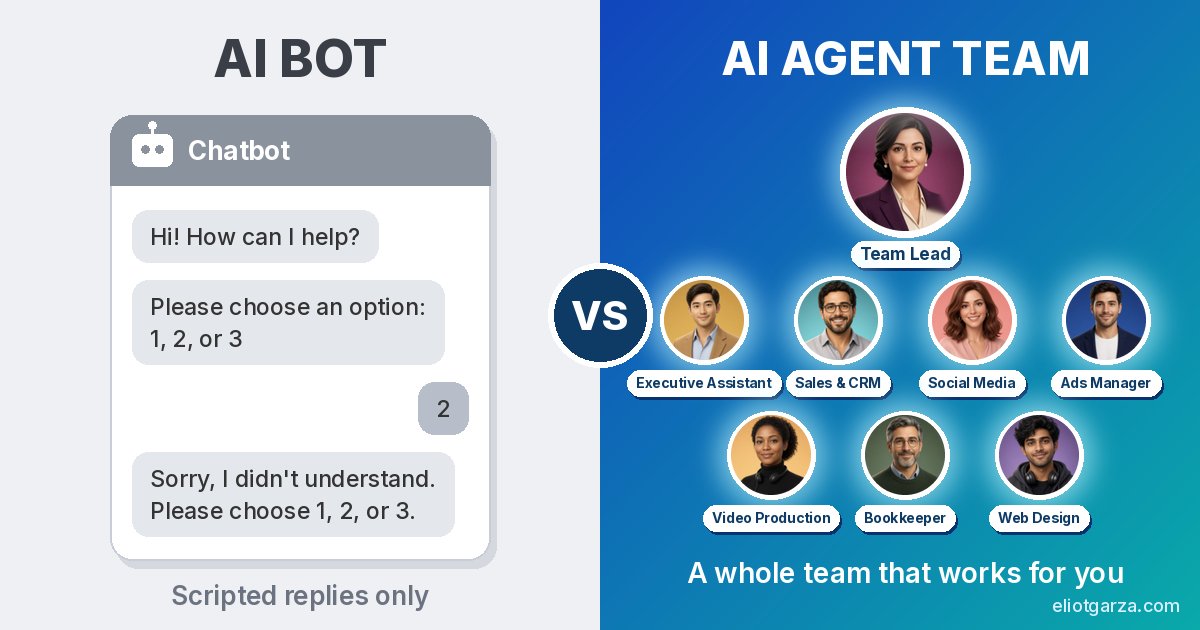
You’ve probably heard another business owner say, “We added AI.” Sometimes that means a chatbot. Sometimes it means an AI agent. They sound alike, but they do very different jobs, and picking the wrong one can cost you time, money, and leads.
So let’s clear it up in plain English. Here’s the short version:
A bot answers. An agent gets things done.
What a chatbot actually is
A traditional chatbot follows a script. Someone built a decision tree ahead of time: if the customer clicks “Hours,” show the hours. If they type “pricing,” show the pricing page. If they ask anything the script didn’t plan for, the bot says something like, “Sorry, I didn’t understand that. Please call our office.”
Think of it like an answering machine with a menu. It’s helpful for simple, predictable questions, and there’s nothing wrong with that. But it can’t think through a situation, and it can’t do anything outside the box it was built in.
What an AI agent actually is
An AI agent understands requests in everyday language, figures out what the person needs, and then takes action for you, within the rules you set.
That last part is the big difference. An agent can be connected to your tools: your calendar, your CRM, your text messaging, your email. So instead of just telling a customer “call us to book,” it can check your availability, book the appointment, send a confirmation, and log the whole thing in your CRM. And when a conversation needs a real person, a good agent knows when to hand it off.
If a chatbot is an answering machine, an AI agent is more like a digital team member who can actually finish the task.
Three real-world examples
1. The missed call after hours.
A potential customer calls at 7:30 PM. Nobody’s in the office.
– With a chatbot: Maybe the caller ends up on your website and clicks through a menu. Maybe they just call your competitor.
– With an AI agent: The agent can text the caller back right away, ask what they need, answer common questions, and offer times to come in. By the time you open up in the morning, that lead is already a booked appointment, not a voicemail you have to chase.
2. Booking an appointment.
A customer writes, “Can I come in sometime Thursday afternoon? I’m off after 2.”
– With a chatbot: It sends a link to your booking page, if the script recognizes the question at all.
– With an AI agent: It reads the request, checks your calendar for Thursday after 2, offers the open times, books the one they choose, and sends a reminder the day before.
3. Following up on leads in your CRM.
A lead filled out your form last week and went quiet.
– With a chatbot: Nothing happens. Chatbots wait for someone to start the conversation.
– With an AI agent: It can follow up on a schedule you approve, answer questions when the lead replies, update the lead’s stage in your CRM (for example, from “New Lead” to “Booked”), and flag the hot ones for you or your team to call personally.
That’s what people mean when they talk about an “AI-customized CRM.” It’s not a fancy new database. It’s your CRM with an agent working inside it, so leads don’t sit and go cold.
Side-by-side comparison
| Chatbot | AI Agent | |
|---|---|---|
| How it works | Follows a pre-written script or menu | Understands everyday language and reasons through the request |
| Handles unexpected questions | Usually not; it gets stuck or redirects | Yes, within the guardrails you set |
| Takes action | Rarely; mostly shares info or links | Books appointments, sends follow-ups, updates your CRM |
| Connects to your tools | Limited | Calendar, CRM, texting, email, and more |
| Starts conversations | No, waits for the customer | Yes, can follow up on a schedule you approve |
| Hands off to a person | Basic (“call our office”) | Knows when to escalate and passes along context |
| Best for | Simple FAQs: hours, location, directions | Lead response, booking, and follow-up that drive revenue |
| Setup | Quick and simple | Takes more planning: rules, tone, and connected tools |
So which one does your business need?
Here’s how I coach owners through this decision. Ask yourself three questions:
1. Are my customers mostly asking the same few simple questions?
If people mainly want your hours, address, and a link to your menu or services, a simple chatbot (or even a better FAQ page) might be all you need right now.
2. Am I losing leads because nobody responds fast enough?
Missed calls, after-hours form fills, leads that never got a second follow-up. If this sounds familiar, that’s where an AI agent earns its keep. Speed to lead matters, and an agent doesn’t clock out at 5.
3. Is my team spending hours on repetitive follow-up?
Reminder texts, rescheduling, “just checking in” messages, updating the CRM. That repeatable work is exactly what an agent can take off your plate, so your people can focus on relationships and closing.
If you answered “yes” to the second or third question, you’re probably ready to look at an AI agent.
Where to start (without overwhelming yourself)
You don’t have to automate your whole business at once. In fact, please don’t. Start with one gap:
- Test your own speed to lead. After hours, call your main line or fill out your own website form, and watch the clock. How long until someone, or something, responds?
- Pick the single biggest leak. For most small businesses, it’s missed calls or slow follow-up.
- Set the rules first. Decide what the agent can do on its own, what it should never do, and when it should hand off to a real person.
- Keep a human in the loop. AI should support your team, not replace the relationships that built your business.
Once that first piece is working, you’ll see clearly where the next one should go.
Let’s map out your next step
AI doesn’t have to be confusing, and it doesn’t have to be all or nothing. The right tool depends on where your time and your leads are slipping through the cracks.
If you’re not sure whether you need a chatbot, an AI agent, or neither yet, that’s exactly what a strategy call is for. We’ll look at your business together and map out a few practical next steps for 2027. No pressure, no jargon.
Book a strategy call with Eliot →
— Eliot Garza, Founder, Media Digital Source